Now Reading: AI Keyword Research & Tools That Actually Work in 2026
-
01
AI Keyword Research & Tools That Actually Work in 2026
AI Keyword Research & Tools That Actually Work in 2026

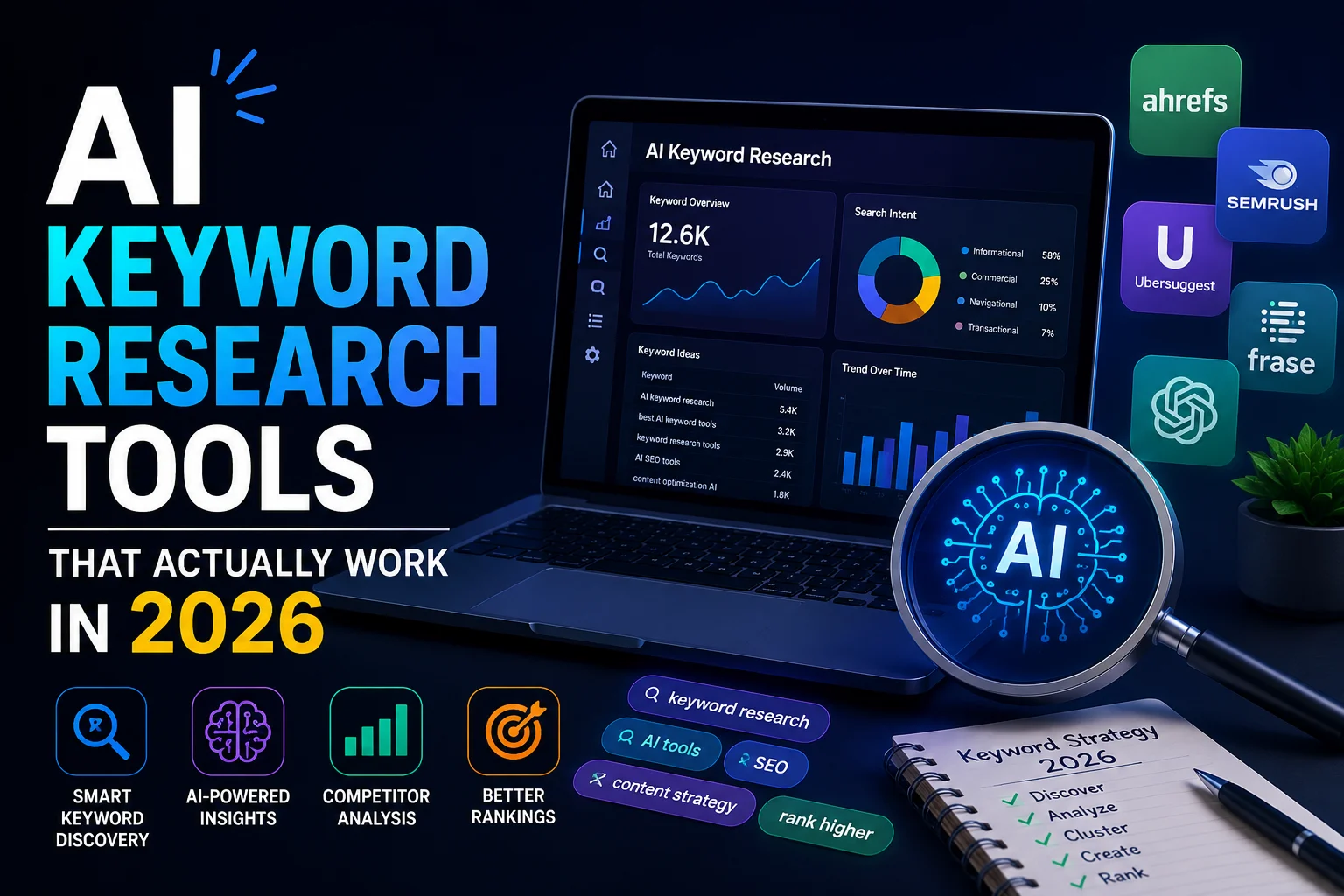
AI keyword research uses artificial intelligence to identify, analyze, and group keywords based on search intent, competition, and semantic relevance. Instead of manually sifting through data, AI tools automate clustering, gap analysis, and content mapping helping SEOs and content creators build smarter strategies in a fraction of the time.
Introduction
Keyword research used to be a grind. You’d load up a spreadsheet, export thousands of rows from a handful of tools, manually sort by volume and difficulty, then try to make sense of what topics to actually write about. For anyone doing SEO at scale or even just for a single website that process could eat an entire workday.
That’s changed significantly. AI keyword research has moved from a novelty to a legitimate workflow accelerator. In 2026, most serious SEO professionals use some form of AI in their keyword process whether it’s a built-in feature inside platforms like Semrush or Ahrefs, a standalone AI keyword tool, or even a custom GPT-based prompt workflow built in house.
But there’s a problem. A lot of the content about AI keyword research treats it like a magic button. Type a topic, press generate, post the content. That approach produces mediocre results and misses the real power of what these tools can actually do.
This guide is different. It covers how AI keyword research actually works, what the tools are genuinely good at versus where they fall short, and how to build a practical AI SEO workflow whether you’re a complete beginner or a seasoned professional.
What Is AI Keyword Research?
AI keyword research is the process of using machine learning and natural language processing to discover, evaluate, and organize keywords more efficiently than traditional manual methods.
Traditional keyword research relies on database lookups you enter a seed keyword, and the tool returns volume, CPC, and difficulty scores pulled from aggregated data. It’s useful, but it’s largely mechanical.
AI keyword research does something different. It understands context. A good AI keyword tool can:
- Recognize the intent behind a search query (informational, commercial, transactional, navigational)
- Group semantically related keywords automatically, even if they use different phrasing
- Identify which keywords a competitor ranks for that you don’t
- Suggest content angles based on what users are actually asking
- Map keywords to stages of the buyer’s journey
The underlying technology varies by tool. Some use large language models (LLMs) like GPT-4 or Claude to interpret and generate keyword ideas. Others use ML models trained specifically on search data. Many platforms now combine both.

Why AI Keyword Research Matters More in 2026?
Search has changed. Google’s Search Generative Experience (SGE) and AI-powered results have shifted how queries get answered. More zero-click searches. More conversational queries. More emphasis on topical depth over individual keyword targeting.
In that environment, targeting isolated keywords the way SEOs did in 2019 is increasingly ineffective. What works now is building topical authority covering a subject comprehensively enough that search engines trust your site as a reliable source on that topic.
AI keyword research tools are built for exactly this. Rather than giving you a flat list of keywords, they help you understand the shape of a topic what subtopics matter, what questions users ask at each stage, and how to structure your content to cover it all.
For business owners and professionals who don’t have the bandwidth to become SEO experts, AI also lowers the barrier significantly. You can get a working keyword strategy in an afternoon rather than a week.
How AI Keyword Tools Actually Work?
The Difference Between AI-Generated and Database-Pulled Keywords
Most traditional keyword tools Google Keyword Planner, Ahrefs, Semrush work from crawled and aggregated data. They show you what people have searched for. Volume numbers are estimates, but they’re grounded in real search data.
AI keyword generators work differently. Some tools use language models to predict relevant keywords based on patterns learned during training. These are useful for brainstorming and uncovering long-tail queries, but they don’t inherently have access to real-time search volume. The best AI SEO tools combine both: generative suggestions layered on top of real search data.
When you’re evaluating an AI keyword tool, it’s worth asking: where does the volume data come from? If it’s purely LLM-generated, treat those keyword suggestions as research prompts, not confirmed opportunities.
Search Intent Classification
One area where AI genuinely outperforms manual methods is intent classification. Sorting 500 keywords by intent type used to mean reading each one individually and making a judgment call. AI tools can batch-classify hundreds of keywords in seconds.
Most systems classify into four buckets:
- Informational — user wants to learn something
- Navigational — user wants to find a specific site or page
- Commercial — user is researching before a purchase
- Transactional — user wants to buy or sign up now
Getting this right affects your content strategy significantly. Writing a detailed educational article to target a transactional keyword wastes effort. AI classification isn’t perfect, but it’s good enough to save hours of manual sorting.
Step-by-Step: Building an AI SEO Workflow for Keyword Research
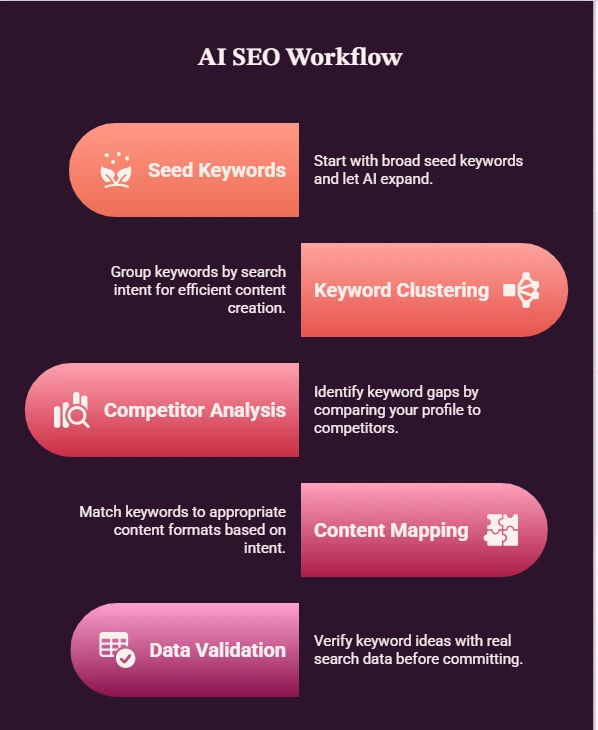
Step 1: Start with Seed Keywords, Not Final Answers
The biggest mistake beginners make is expecting an AI keyword tool to hand them a complete strategy. Don’t. Start with 3–5 broad seed keywords that represent your topic or niche, then let the AI expand from there.
For example, if your site covers productivity tools for remote workers, you might start with:
- remote work tools
- productivity apps
- work from home setup
- time management software
- async communication
Feed those into your AI keyword tool and let it generate related terms, questions, and variations.
Step 2: Use AI for Keyword Clustering
Keyword clustering is where AI adds the most obvious value. The goal is to group keywords that share the same search intent and could reasonably be covered in one piece of content rather than creating separate pages for every minor variation.
Before AI tools, clustering was done by hand or with Python scripts. Now, platforms like Semrush, Surfer SEO, and Keyword Insights handle this automatically. You upload a list, the AI groups by semantic similarity and SERP overlap, and you get a clustered map you can turn directly into a content calendar.
A well-clustered keyword strategy prevents keyword cannibalization (where two of your pages compete for the same term) and makes your site structure cleaner.
Practical tip: Don’t fully trust the AI clusters without sanity-checking them manually. Sometimes the algorithm groups keywords together that don’t actually make sense to cover in the same article. A quick scan of the top-ranking pages for each cluster will tell you whether Google treats them as the same topic or separate ones.
Step 3: Analyze Competitor Keyword Gaps
One of the most underused features in AI keyword research is gap analysis. Most major platforms now let you compare your keyword profile against competitors and surface terms they rank for that you don’t.
AI makes this smarter by filtering out irrelevant gaps competitor keywords that don’t match your site’s focus or have misaligned intent. It prioritizes opportunities that are realistic given your domain authority and content mix.
This is particularly valuable for business owners who want quick wins. Rather than targeting extremely competitive head terms, gap analysis surfaces mid-tail keywords where you have a genuine chance to rank.
Step 4: Map Keywords to Content Types
Not every keyword needs a 3,000-word guide. An AI SEO workflow should include a step where you match each keyword cluster to the right content format:
| Keyword Intent | Recommended Format |
| Informational / broad | Long-form guide or pillar page |
| Informational / specific | Focused how-to article or FAQ page |
| Commercial | Comparison article, review, or best-of list |
| Transactional | Product page, landing page, or category page |
| Navigational | Brand/about page |
AI tools with NLP capabilities can suggest this mapping automatically. Treat it as a starting point, not gospel editorial judgment still matters.
Step 5: Validate with Real Search Data
AI-generated keyword ideas are starting points. Before you commit to writing a piece of content, verify:
- Search volume — is there enough monthly traffic potential to justify the effort?
- Keyword difficulty — is your site competitive enough to realistically rank?
- SERP features — are featured snippets, People Also Ask boxes, or video carousels taking up the real estate?
- Current ranking — are you already on page 2 or 3 for this keyword? Optimization might outperform new content.
Google Search Console, Ahrefs, and Semrush all provide this validation layer. Use AI to generate the ideas; use real data to prioritize them.
The Best AI Keyword Research Tools in 2026
Rather than ranking every platform exhaustively, here’s an honest breakdown of what different tools are strongest at:
Semrush with AI features
Best all-in-one for professionals. Strong gap analysis, keyword clustering, and content brief generation baked into one platform. Higher price point, but the data quality is among the best.
Surfer SEO
Particularly strong at keyword clustering and on-page optimization. The content editor integrates keyword recommendations directly into your writing workflow.
Keyword Insights
Purpose-built for keyword clustering at scale. If you work with large keyword lists (5,000+ terms), this is worth trying.
ChatGPT / Claude with custom prompts
Surprisingly useful for brainstorming long-tail questions, generating semantic keyword variants, and drafting content briefs. The limitation is no real-time search volume data you’re working from training knowledge, not live SERP data.
Perplexity AI
Good for understanding what questions real users are asking around a topic. Useful early in the research process to understand user language.
Google Search Console (free)
Often overlooked but incredibly valuable. Shows you exactly what queries your site already gets impressions for. Combine with AI tools for a complete picture.
Common Mistakes in AI Keyword Research
Taking AI-generated volume numbers at face value
Some tools present AI-estimated search volumes as if they’re as reliable as Ahrefs or Google data. They’re not. Always cross-reference.
Skipping the clustering step
Generating 500 keywords and writing articles for each one individually is an old approach. Without clustering, you’ll create cannibalization problems and miss topical authority opportunities.
Over-relying on AI for intent classification
AI classifies intent well for clear-cut cases, but ambiguous keywords still need a human look. Searching the keyword yourself and seeing what Google actually returns is the only way to confirm.
Ignoring seasonal and trending variation
AI tools trained on historical data won’t catch emerging search trends. Layer in Google Trends for any keyword research in fast-moving industries.
Not iterating
AI keyword research isn’t a one-time exercise. Search behavior shifts. New competitors appear. Revisiting your keyword strategy quarterly with fresh AI analysis keeps your content strategy current.
AI Keyword Research for Beginners: Where to Start
If you’re new to SEO and feeling overwhelmed by the tools and terminology, here’s the simplest path forward:
- Write down 5 topics your target audience cares about. Don’t overthink it.
- Use a free or low-cost AI tool (ChatGPT, Google’s keyword planner, or Ubersuggest’s AI features) to expand those topics into keyword lists.
- Focus on questions. Long-tail, question-based keywords (“how to,” “what is,” “best way to”) are less competitive and easier to rank for when your site is new.
- Pick 3–5 keywords to start. Quality beats quantity. Write one thorough, genuinely helpful article per cluster.
- Track your results. Set up Google Search Console from day one and review it monthly.
You don’t need a $200/month platform to get started. The expensive tools become worth it once you’re managing larger content operations or need competitive intelligence.
Advanced AI Keyword Analysis:
For professionals building out content strategies at scale, these are the techniques that separate good keyword research from great keyword research:
Entity-based keyword mapping
Modern search engines don’t just match keywords. they recognize entities (people, places, concepts, brands). AI tools that map keywords to entities help you build content that search engines can understand structurally, not just textually.
Semantic keyword expansion
Beyond synonyms, semantic expansion means finding related concepts that should naturally appear in content around your main keyword. NLP-based tools analyze top-ranking pages and surface these terms automatically. Including them improves content depth and reduces the risk of thin content penalties.
AI-assisted content gap identification at the site level
Rather than looking at individual keyword gaps, advanced workflows compare your site’s overall topical coverage against competitor sites. This reveals entire subtopics or content clusters you haven’t touched yet.
Search intent evolution tracking
User intent around specific keywords changes over time, especially in technology, health, and finance verticals. AI systems that monitor SERP changes can alert you when the intent behind a keyword shifts which might mean your existing content needs updating.
FAQ Section
Q1: What is AI keyword research and how does it work?
AI keyword research uses natural language processing and machine learning to identify, group, and prioritize keywords. The AI analyzes semantic relationships, search intent patterns, and competitive data to produce insights that go beyond basic keyword lists.
Q2: Which AI keyword tool is best for beginners?
Ubersuggest with AI features and ChatGPT with guided prompts are accessible starting points. Both offer free access, and neither requires deep SEO knowledge to use.
Q3: How does keyword clustering AI save time?
Instead of manually sorting thousands of keywords into topic groups, AI clustering tools analyze semantic similarity and SERP data to group them automatically cutting hours of work to minutes.
Q4: Do I still need traditional SEO tools if I use AI?
Yes. AI tools excel at generation, clustering, and intent analysis. Traditional tools like Ahrefs and Semrush provide reliable volume and difficulty data. The two work best together.
Q5: How accurate is AI keyword analysis for search volume?
It depends on the data source. AI tools that pull from Google’s API or their own crawl data are reliable. Pure LLM-generated volume estimates should be treated as rough guides only.
Q6: Can AI keyword research help with Google E-E-A-T?
Indirectly, yes. AI research helps you identify what topics to cover in depth, which contributes to demonstrating expertise and authority. But E-E-A-T is ultimately about content quality, not just keyword coverage.
Q7: What is an AI SEO workflow?
A step-by-step process integrating AI at each stage: keyword discovery, clustering, content brief creation, optimization, and performance review. It replaces manual, fragmented processes with a streamlined system.
Q8: Is AI keyword research suitable for small businesses?
Absolutely. Small businesses with limited budgets can use free AI tools for research and focus their efforts on realistic long-tail opportunities rather than competing for high-difficulty head terms.
Q9: How does AI handle search intent classification?
AI tools use NLP models trained on large SERP datasets to classify queries as informational, navigational, commercial, or transactional. Accuracy is high for clear-cut cases; ambiguous queries may need manual review.
Q10: What are the risks of relying too heavily on AI for keyword research?
Over-reliance can produce strategies based on pattern matching rather than genuine user understanding. It can also introduce errors if volume data is poorly sourced. Use AI as a research accelerator, not a strategy replacement.